Peculiar Pirates: Reclaiming the Skull and Crossbones
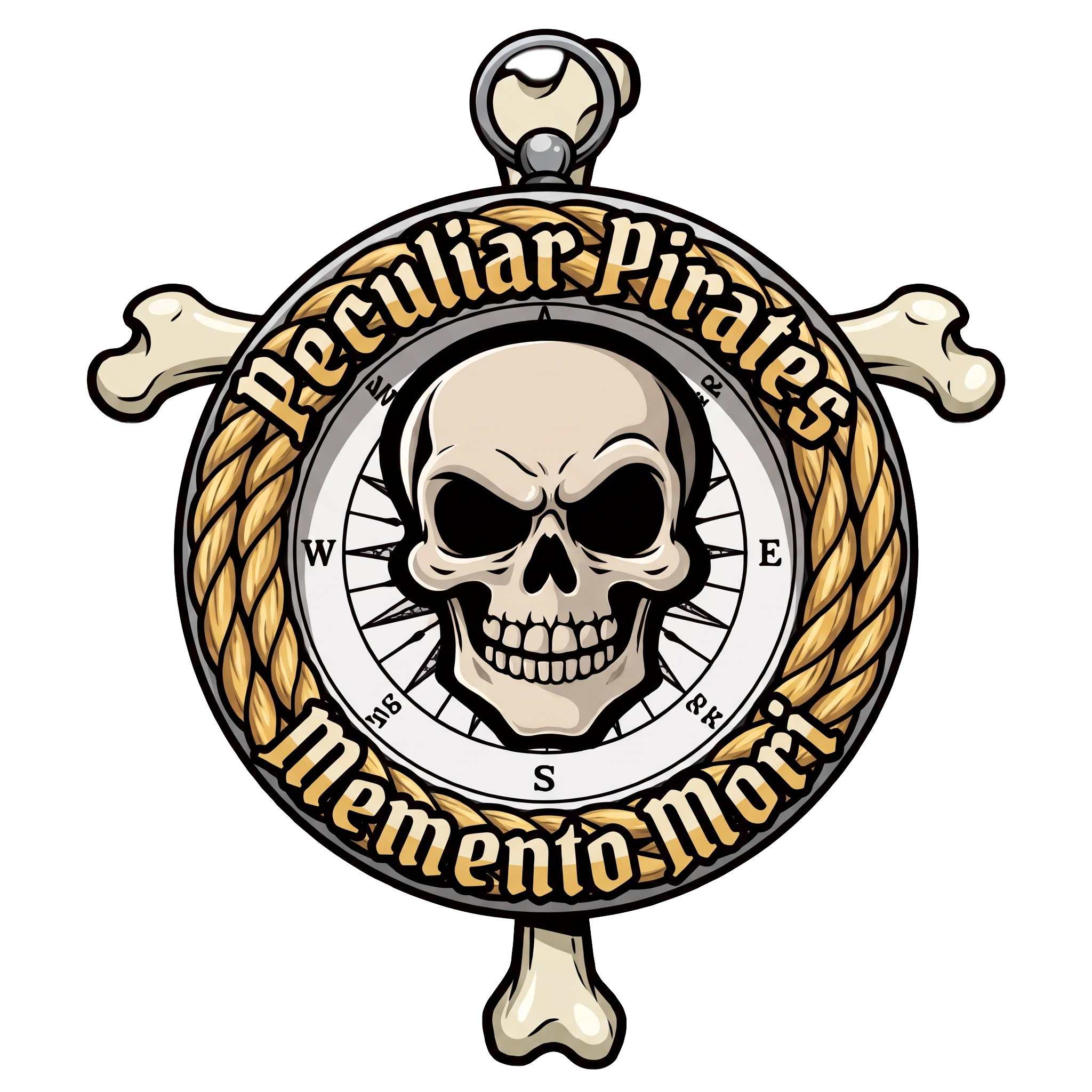
Our crest puts a skull and crossbones under the words Memento Mori because we are reversing what the pirates did with it. Long before pirates flew it, the skull and crossbones was a Christian symbol. It reminded believers that they are mortal, and it pointed to death defeated at the cross.
Around 1700, pirates borrowed a sign everyone already read as death and turned it into a threat: fear death, and surrender. We take it back. Two convictions shape how we read it:
- We are not God. We are mortal and our time is limited. Remembering that keeps us humble and honest.
- We do not fear death. Christ has broken death’s power, so we are free to play, serve and love with purpose today.
How the meaning turned
Pirates and Peculiar Pirates, side by side
| Pirates, c. 1700 | Peculiar Pirates | |
|---|---|---|
| What the skull says | You will die if you resist | Remember you will die: you are not God |
| What death is | A weapon to make others afraid | Defeated at the cross, so we need not fear it |
| What the hourglass says | Your time is up | Number our days and live well today |
| How the crew rules | By fear | By love and service |
| Why they land on a shore | To carry off loot | “We land to break chains” |
| What the crew carries | Plunder | Music and service “to bless our school and our community” |
The quoted lines come from our own storyline on the Senior Band page.
Remember you are not God
The oldest root of the skull’s meaning is memento mori, “remember that you will die,” and it began as a check on pride.
- Tertullian, around 197 AD. The Christian writer described a voice behind a Roman general in his triumph: “Look behind thee; remember thou art but a man.” He used it to argue that even the emperor is not God (Apology, ch. 33).
- Scripture. “For dust you are and to dust you will return” (Genesis 3:19), words echoed over Christians every Ash Wednesday. “Teach us to number our days, that we may gain a heart of wisdom” (Psalm 90:12).
- Tombs and churchyards. From the late Middle Ages, the skull and crossbones was carved on tombstones as a memento mori. Spanish cemeteries marked their gates with real skulls and bones, and Puritan gravestones in colonial America carried winged skulls.
In Christian use, the reminder was never meant to frighten. It puts us in our place as creatures, not the Creator, and turns our thoughts from passing things toward God and the life to come.
Death defeated: the skull beneath the cross
Many crucifixes show a skull and crossed bones beneath Christ, and the image proclaims death defeated, not death in charge.
- The place of the skull. Jesus was crucified at “a place called Golgotha (which means ‘the place of the skull’)” (Matthew 27:33).
- Adam’s grave. Origen of Alexandria (c. 185–253) recorded a tradition that Adam was buried there. In the 4th century, Athanasius, Epiphanius of Salamis and John Chrysostom repeated it.
- In art. By the early 12th century, a Byzantine mosaic at Hosios Loukas in Greece showed a skull at the foot of the cross with Christ’s blood flowing onto it. Many later crucifixes carry a skull and crossed bones beneath Christ.
The meaning is the gospel in one picture: “For as in Adam all die, so in Christ all will be made alive” (1 Corinthians 15:22). The skull of the first Adam lies beneath the cross of the “last Adam” (1 Corinthians 15:45), whose death undoes the death that came through Adam.
This is why Christians need not fear death. Christ shared our humanity “so that by his death he might break the power of him who holds the power of death … and free those who all their lives were held in slavery by their fear of death” (Hebrews 2:14–15). Paul can even taunt it: “Where, O death, is your victory? Where, O death, is your sting?” (1 Corinthians 15:55).
How the pirates turned it around
Pirates did not invent the skull and crossbones. Around 1700 they borrowed a sign everyone already read as death and made it a threat.
- Ship’s logbooks. Captains marked a crew member’s death in the log with a skull and crossed bones, so every sailor knew the sign.
- The first recorded pirate flag. In 1700, Captain John Cranby of HMS Poole saw Emanuel Wynn’s black flag off the Cape Verde islands. It carried a death’s head, crossed bones and an hourglass.
- The golden age. Between 1717 and 1721, newspapers and captains described many “death’s head” flags. In 1720 the Boston Gazette reported Bartholomew Roberts flying “a Black Flag with Death’s head and a cutlass in it.”
The hourglass was itself a memento mori emblem. Pirates kept the reminder that time runs out but aimed it at their victims: surrender, or die. Historian Marcus Rediker titled his study of these crews Under the Banner of King Death. The flag used the fear of death to rule other people.
Two cautions belong here. No pirate wrote down why they chose the symbol, so the link to Christian imagery is historians’ reading of a visual culture everyone shared. And the popular story that the Knights Templar became pirates and gave them the flag has no evidence behind it; it comes from much later Masonic legend.
How the Peculiar Pirates turn it back
We are peculiar because we reverse the pirates’ reversal. The skull on our crest reminds us that we are mortal, and it frees us instead of threatening anyone.
The word itself comes from Scripture. The King James Version calls God’s people “a peculiar people,” called “out of darkness into his marvellous light” (1 Peter 2:9) and “zealous of good works” (Titus 2:14).
In the band, memento mori keeps us honest about how short and precious our time together is, so we choose to play, serve and love with purpose. The compass on our crest points four ways: toward God, toward ourselves, toward one another and toward creation.
An older sailor’s symbol: the anchor of hope
The earliest Christians used a sailor’s symbol of their own, the anchor, to say that death did not frighten them.
- Where it appears. On epitaphs in the Roman catacombs of Priscilla, Domitilla and Callixtus, mostly from the 2nd and 3rd centuries. The earliest example dates to the end of the 1st century.
- What it meant. Hope of salvation, from Hebrews 6:19: “We have this hope as an anchor for the soul, firm and secure.” Epitaphs often paired it with in pace, “in peace.”
- A hidden cross. Crosses were rare in Christian art before the 4th century, so an upright anchor could also signal the cross.
The skull says remember that you will die. The anchor says why that need not frighten us.
Sources
Scripture quotations are from the NIV, except 1 Peter 2:9 and Titus 2:14 (KJV).
- Tertullian, Apology, chapter 33 – Logos Library
- Memento mori – Wikipedia
- Skull and crossbones (symbol) – Wikipedia
- Skull and crossbones (cemetery) – Wikipedia
- Calvary – Wikipedia
- The Skull of Adam and Christ’s Crucifixion – manchistorian
- Is It True that the Skull of Adam Was Beneath the Cross of Christ? – catholicism.org
- 1700: The Jolly Roger – libcom
- Why Did Pirates Fly the Jolly Roger? – Scientific American
- Emanuel Wynn – Wikipedia
- Jolly Roger – Wikipedia
- Curse of Oak Island repeats claim that Jolly Roger is a Templar symbol – Jason Colavito
- Anchor (as Symbol) – EWTN


